

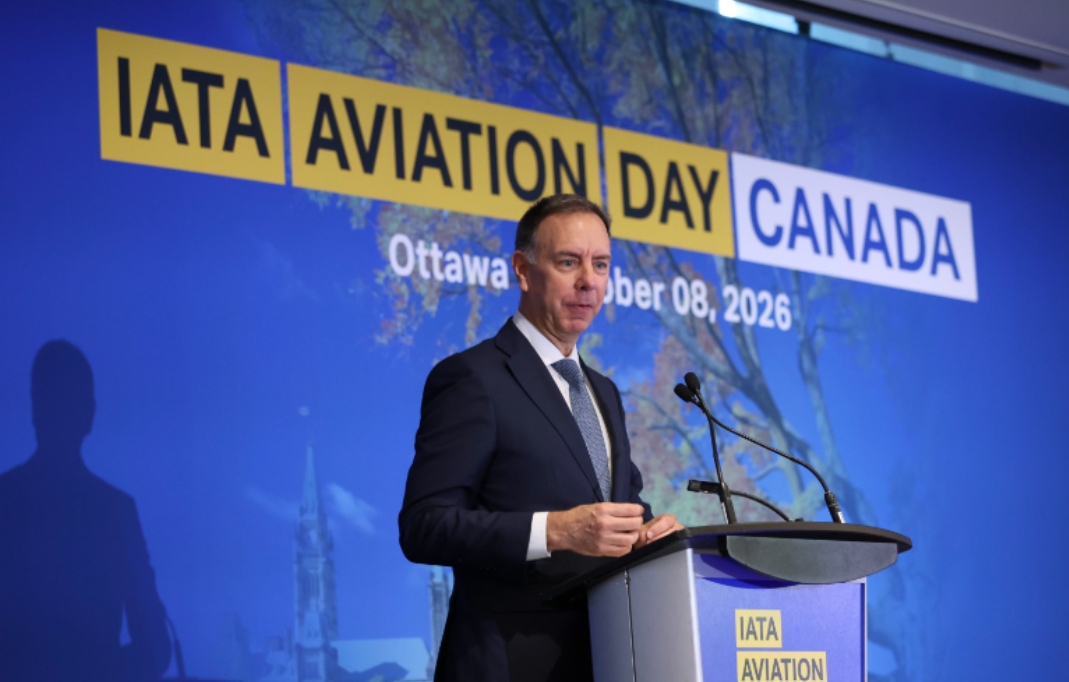
Aviation Day Canada is taking place today in Ottawa, bringing together more than 300 representatives from across the aviation industry to examine the main challenges and opportunities facing Canadian air transport. Organized by the International Air Transport Association (IATA) and the National Airlines Council of Canada (NACC), the event is addressing key issues including competitiveness, connectivity, infrastructure, sustainability and costs.
Steven MacKinnon, Canada’s Minister of Transport, opened the event by highlighting aviation’s essential role in bringing families together, connecting remote communities and helping businesses access international markets. He also underscored the importance of cooperation between government and industry to build an aviation system capable of meeting Canada’s future needs.
Peter Cerdá, IATA’s Regional Vice President for the Americas, reinforced this message, stressing that public-private collaboration will be critical to strengthening the sector. Among the priorities he identified were improving competitiveness and affordability, modernizing infrastructure, advancing sustainability, addressing supply chain constraints and preserving connectivity for rural and remote communities.
“In a country as vast as this one, aviation is not simply transportation. It is an economic enabler, a social connector, and for many communities, an essential service,” he said.
According to IATA’s latest Value of Air Transport report, aviation supports more than 830,000 jobs in Canada and generates approximately CAD$137 billion in economic output.
Cerdá said Canada must strike a balance between the investments required to support aviation growth and the need to keep air travel affordable. In this context, IATA welcomed the Government’s commitment to improving the affordability of air travel while reiterating its concerns about the impact of taxes, fees and other costs.
Regarding airport modernization, he said investments should be demand-driven, cost-efficient and developed in coordination with passengers and airlines. He also addressed the debate over airport governance, arguing that the discussion should focus more on outcomes than on ownership models.
“The focus should not be ownership. The focus should be on outcomes,” Cerdá said, noting that these outcomes should translate into better services and connectivity for passengers, an environment that enables airlines to compete effectively and a stronger contribution to economic growth.
He also highlighted the Sustainable Aviation Fuel Blueprint as an important step toward developing a sustainable aviation fuel (SAF) industry in Canada, an objective that will require coordinated action among government, fuel producers, airports, manufacturers and airlines.
Cerdá also warned that shortages of aircraft parts and engines, along with constraints in maintenance capacity, continue to limit growth and drive up costs. He therefore called for greater competition and flexibility across aviation supply chains.
Keeping Canada connected
Cerdá also focused on rural, remote and northern communities, where aviation is essential for accessing healthcare, education and economic opportunities, while also supporting tourism, trade and investment.
To illustrate the value of connectivity, he recalled Gander’s response following the September 11, 2001 attacks, when the community welcomed nearly 7,000 passengers from 38 diverted flights after North American airspace was closed.
“When people come together with a shared purpose, extraordinary things can happen,” he emphasized.
For IATA, cooperation among government, airlines, airports, regulators and other stakeholders will be critical to strengthening Canadian aviation, supporting its growth and keeping the country connected, both among its own communities and with the rest of the world.
You can access the speech here
You can access the presentation here