

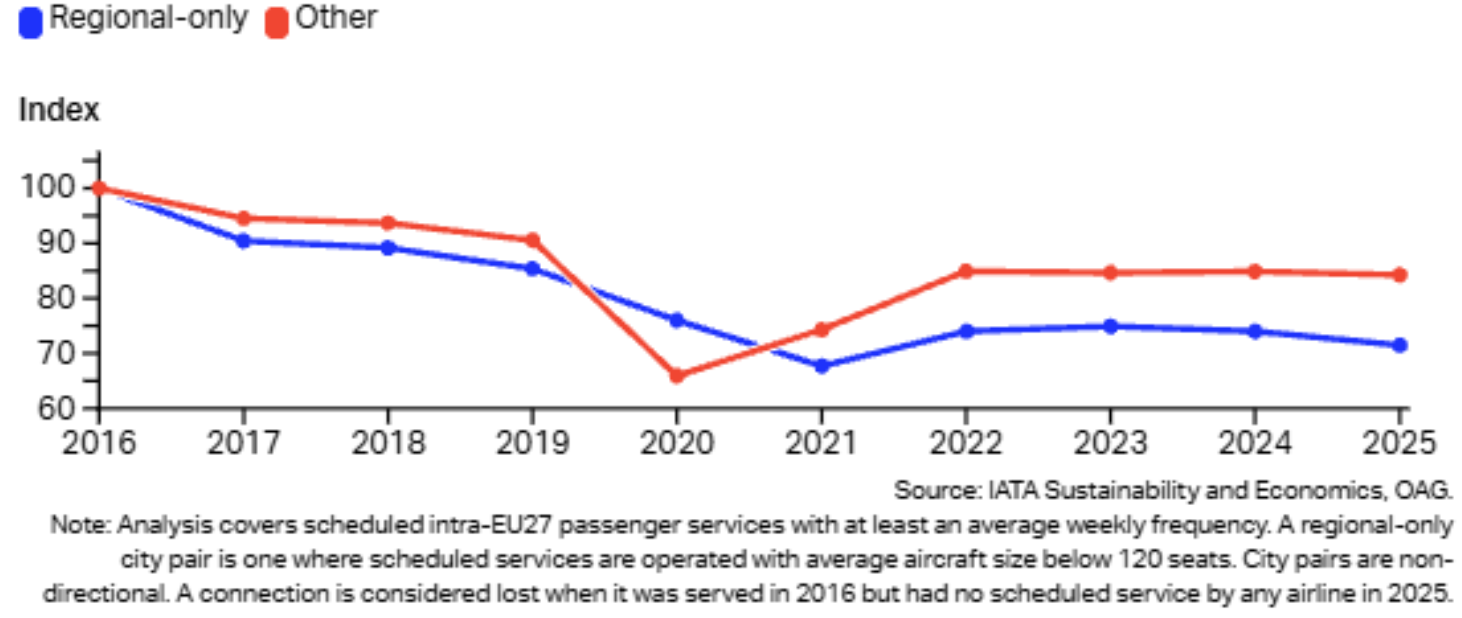
While Europe’s intra-EU air network has grown over the past decade, connectivity reliant on regional aircraft has been far more fragile.
Among the 554 city pairs served exclusively by regional aircraft in 2016, 28.5% were no longer connected by any airline in 2025, compared with 15.7% of other city pairs. Regional-only routes were therefore 1.8 times more likely to disappear, highlighting their vulnerability and the difficulties of maintaining regional connectivity.
Regional air services typically serve thinner markets, where the economics of connectivity are more fragile. Although smaller aircraft allow capacity to be matched to lower demand, limited passenger volumes constrain economies of scale and reduce operators’ ability to absorb rising costs.
Consequently, these routes are especially vulnerable to increases in fuel, labor, airport, tax, and regulatory expenses. Unlike larger markets, where capacity may be replaced or consolidated, the withdrawal of regional services frequently results in the complete loss of air connectivity.
Regional-only connections represented 21% of intra-EU city pairs in 2016 but accounted for 32% of all routes lost by 2025. The disproportionate decline of these services is particularly concerning, as they often provide smaller and peripheral communities with essential access to jobs, healthcare, education, and economic activity. The erosion of regional air services points to a wider challenge for European connectivity.
The routes most vulnerable to commercial pressures are frequently those with the greatest strategic importance for the communities they serve. Ensuring their survival therefore depends not only on underlying demand, but also on preventing operating and regulatory costs from rising to levels that undermine the viability of these inherently thin markets.