

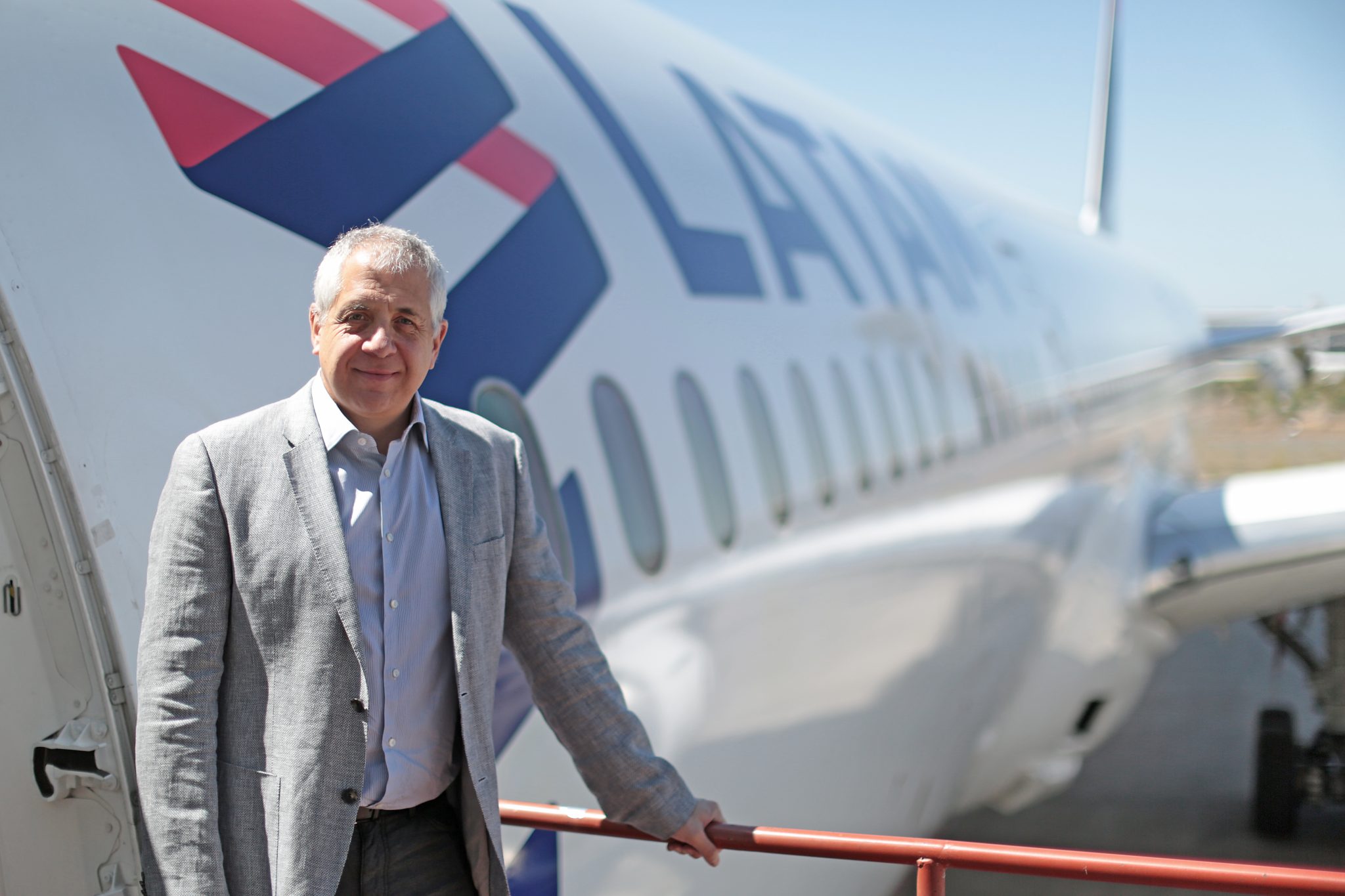
On the eve of the 82nd IATA Annual General Meeting (AGM), which will begin tomorrow in Rio de Janeiro, Brazil and will be hosted by LATAM Airlines Group, its CEO, Roberto Alvo, gave an exclusive interview to Graham Newton for IATA’s Airlines Magazine.
What are the main reasons behind the airline’s strong financial and operational performance?
The most important change was to stop seeing results as the goal and start seeing them as the consequence of doing other things well; taking care of the people who work with us, genuinely serving our customers, and contributing to the communities in which we operate.
That reordering of priorities changed everything. We reinforced this with a business model focused on our passengers, a differentiated value proposition, consistent operational execution, and, of course, strong financial discipline. Today, all of this gives LATAM the flexibility needed to face the challenges that arise along the way.
What do you hope to achieve with the transformation of your products and services?
We aim to close the gap between what a passenger expects and what they experience when flying with us. The focus is on offering a consistent, high-standard experience across the entire operation, which is a significant challenge in such a large network.
We have learned that it is not just about investment, but about empathy and putting the passenger at the center. To achieve this, people are key. Our team is the foundation of everything. This has allowed us to improve punctuality and net promoter score and to achieve Skytrax’s four-star certification. The challenge now is to sustain and scale that standard.
What are the main opportunities and challenges of operating in the region?
In South America, long distances and the lack of efficient ground transportation make aviation vital for connectivity and development. Although the industry has expanded access to flying, penetration remains low at just 0.6 trips per capita in the region, compared with more than 2 in the United States, and 5 in Spain. This shows significant untapped potential.
However, this growth potential coexists with major structural challenges. The region faces high macroeconomic volatility, complex regulatory frameworks, insufficient infrastructure in several markets, and a burden of fees and taxes that, in many cases, are among the highest in the world.
For aviation to reach its potential, a public-private vision is essential. That vision must promote sustainable growth through policies that recognize air travel’s strategic role and foster competitive conditions and adequate infrastructure.
How can we convince governments of the value of aviation?
Latin America is a region where the value of aviation is particularly evident. Due to its geography and distances, it is often the only means of connecting people and opportunities. There is recognition of aviation’s value among governments, particularly in remote areas, where local authorities are fully aware that air connectivity is key for access to healthcare, education, and development.
However, there is still a gap in understanding how the industry works and the conditions it requires to grow sustainably. It is our responsibility as an industry to collaborate with governments to develop a shared vision that promotes long-term public policies, greater connectivity, and broader access to air travel.
Specifically, what changes are needed in the regulatory environment in Brazil?
Brazil represents nearly half of the group’s business and is South America’s largest market. Despite its size and reliance on aviation, it is still far from its potential, with around 0.5 trips per capita per year. To close that gap, more competitive conditions are needed. High fuel costs and an unfavorable tax system for air transport, such as the introduction of value-added tax, on international tickets can increase fares, reduce access, and dampen demand.
It is also essential to advance long-term policies that integrate aviation, tourism, and infrastructure, with coordinated strategies between the public and private sectors.
Improving infrastructure and reducing operational costs, as well as addressing challenges, such as high litigation levels, will help expand the air travel market and consolidate aviation as a driver of development in Brazil. With progress in these areas, Brazil has the potential to become one of the most important aviation markets in the world.
With so much potential for sustainable aviation fuel (SAF) production in Latin America, are you confident that supply will soon match demand?
The potential is undeniable, and in 2021 LATAM announced its goal of achieving up to 5% SAF usage by 2030. Here we are, five years later, and despite the demand signal we aim to provide, there is not a single drop of production, nor do we see projects on the horizon that would turn this from theory into practice.
The region has biomass availability, but lacks consolidated supply chains, industrial infrastructure, and scalable technological capabilities to produce SAF competitively. This gap between potential and reality is what concerns us.
SAF is two to five times more expensive than conventional fuel, and its availability remains limited globally. In this context, it is increasingly clear that the market will not develop on its own. Without public policies that incentivize production—through subsidies, as the United States has done, for example—SAF appears to be an unrealistic and distant solution.
How have you been involved in this issue?
We have actively participated in advancing public-private dialogue. In this regard, we co-financed, together with Airbus, an MIT study published in 2024, which provides scientific information to the governments of six countries to help build appropriate policies.
Based on this, we have also contributed to a new study—developed by ALTA with ICF—that analyzes potential pathways and trade-offs for advancing toward net-zero aviation in Latin America, considering the region’s unique opportunities and challenges. We want to be part of the solution, and not just point out the problem. It requires governments, industry, and producers to move together with the urgency the challenge demands.
Is the net zero emissions target by 2050 achievable?
The net zero emissions target by 2050 is necessary and shared across the industry, but achieving it is becoming increasingly complex. The conflict in the Middle East has highlighted that energy security is more critical than energy diversity, making carbon neutrality targets even more challenging.
This does not mean there are no opportunities. Work can be done on reducing emissions at source, starting with operational efficiency, better airspace management, and fleet renewal. These are the most immediate levers and largely within the control of governments and airlines. These advances will make the reductions expected from SAF in the medium and long term more feasible, provided its production can be scaled and costs significantly reduced.
I believe the goal is achievable, but not solely through SAF. It will depend on economic capacity, government willingness, regulatory and investment decisions, and ensuring that the transition is compatible with the realities of our subcontinent. Progress toward net zero cannot come at the expense of connectivity or access to air transport.
Are you committed to this goal?
We continue working hard to pave a path that makes carbon neutrality viable and have publicly committed to reducing emissions intensity 6% by 2030 compared with 2019. We will manage more than 10.8 million net tons of CO? through fleet renewal, operational efficiency, and SAF integration—depending on its viability at that time. All of this is complemented by offset mechanisms for residual emissions. This constitutes a concrete, measurable, and traceable action plan.
As a result, S&P Global has recognized us as the fifth most sustainable airline in the world and the first in the Western Hemisphere. This recognition reinforces our commitment to continue advancing with rigor and consistency.
How have supply chain issues affected you?
Supply chain disruptions have affected the entire industry, and we are no exception. We are operating in a more complex global context, marked by cost pressures, geopolitical conflicts, and high volatility. LATAM therefore approaches these issues with prudence and confidence. Prudence, because it requires constant monitoring and adaptability. Confidence, because the company is now in a much stronger position than in the past.
At the same time, we understand that such contexts demand discipline. We take nothing for granted and continue working to maintain flexibility and responsiveness in a changing environment.
Do you believe in artificial intelligence (AI), and what use cases do you see for its implementation in the business?
Absolutely, but with a practical perspective. AI is a tool, not a magic solution. The real challenge is not technological—it is cultural and organizational.
Digitalization is often seen as simply implementing systems or improving customer interfaces. But the deeper change lies in how you organize, how processes flow, and how decisions are made.
Historically, airlines, and companies in general, have been structured in functional silos. Each area optimizes its part, but the real business does not work that way. Customers experience the company as a whole, not as a sum of departments. That is why the challenge is to move toward a much more integrated organization, based on end-to-end processes and customer journeys…