
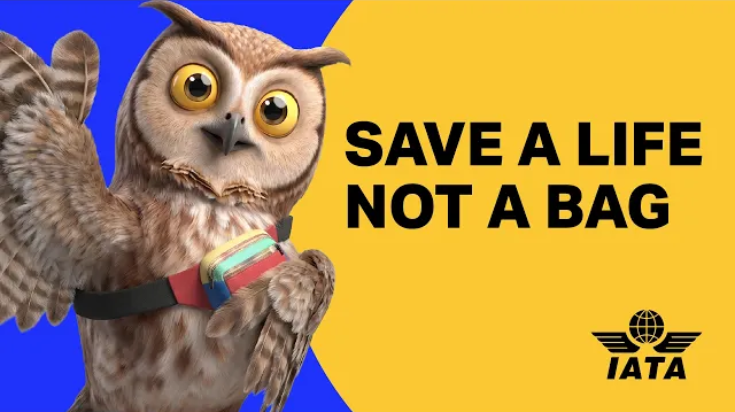
The International Air Transport Association (IATA) today announced the launch of “Save a Life, Not a Bag”, a passenger safety campaign urging travelers not to take cabin baggage during an aircraft evacuation.
Supported by aviation safety regulators including the European Union Aviation Safety Agency (EASA) and the Federal Aviation Administration (FAA) the campaign reinforces what passengers must do when instructed to evacuate for their safety and the safety of all on board: follow crew instructions, leave all baggage behind, and move quickly to the nearest usable exit.
“Taking bags during an evacuation is not a minor issue. Every second matters. Even taking one bag can affect the safe evacuation of everyone onboard. Crew instructions are clear and simple: leave everything behind and move quickly. “Save a Life, Not a Bag” is a message that passengers need to understand and act upon,” said Willie Walsh, IATA’s Director General.
The campaign responds to the growing number of cases where travelers have stopped to collect their baggage or take photos during aircraft evacuations. Evidence of this is seen in many videos posted online.
“Rapid evacuation in an emergency situation saves lives. Aircraft are certified to stringent evacuation standards and crews are trained extensively for emergency situations, to make sure every single passenger has the best possible chance of survival in an acute situation. For this to work in a real emergency, all passengers must play their part too. And it is very simple: follow crew instructions, leave all baggage behind and move quickly to the nearest usable exit. Not only this will save your life, but you will have done your very best to allow everyone to get out of danger,” said Florian Guillermet, EASA Executive Director
Valuable seconds can be lost when retrieving baggage from overhead bins. Carrying bags can cause people to fall or damage the slides that all passengers need to use. Most concerningly, some passengers have been seen attempting to evacuate while carrying both infants and bags or other personal items, compromising safety at a critical moment.
“We are seeing an increasing number of passengers not following flight crew instructions during emergencies. In those moments, compliance is critical. Passengers must act quickly, follow instructions without hesitation, and leave all belongings behind. Safety is a shared responsibility, and informed, attentive passengers help ensure a faster, safer evacuation for everyone on board,” said FAA Administrator Bryan Bedford.
Passenger research helps quantify the need for action
As part of the campaign development, IATA commissioned a survey of recent air travelers in four representative markets (US, UK, UAE, and Singapore), supported by input from behavioral experts.
The research found some critical gaps:
- While 80% of those surveyed claimed to know what to do in an emergency evacuation, only 61% correctly answered that they should leave all personal items and exit the aircraft.
- 33% said that they had seen reports of people taking their baggage during an evacuation. Of these, 22% indicated that they are likely to do the same.
- Many passengers overestimate the time needed for an evacuation. Only 18% know that aircraft evacuation procedures are designed around a 90-second safety benchmark, whereas 38% indicate it could be three minutes or more.
- One in ten passengers admitted they may still take baggage during an evacuation, or follow others who do, even when instructed not to.
- 60% say they would be less likely to take baggage if essential small items were already secured on their person.
“The majority of passengers know what to do in an accident. There is, however, a significant gap in knowledge among some travelers that could result in disaster. Even just a passenger or two taking a few extra seconds to gather personal items can endanger lives. That’s why it’s essential to build good habits for all travelers, like paying attention to safety demonstrations each time and keeping essential items, such as passport, money, and medication on person. It’s also important that passengers understand the consequences of not listening to crew. Save a life, not a Bag is meant to be a blunt reminder of what is at stake for everyone in the rare event of an evacuation,” said Nick Careen, IATA’s Senior Vice President Operations, Safety, and Security.
Taking baggage creates risks for everyone onboard
Taking baggage during an evacuation can slow movement through the cabin, block aisles and exits, prevent passengers from using their hands, and injure others. Bags can also puncture evacuation slides, obscure exit path lighting, become caught on seats or fixtures, and create hazards for crew and rescue personnel outside the aircraft.
The risk is not limited to the person carrying the bag. A single passenger stopping to retrieve luggage can delay others, disrupt crew commands, and affect the use of exits and slides.
Prepare before take-off and landing
The campaign video was developed with input from human behavioral specialists to help ensure the message is clear, memorable, and effective with passengers. It deliberately uses surreal imagery and exaggerated scenarios to leave a lasting impression on viewers.
The campaign encourages passengers to think ahead by keeping essential items such as passport, money, and medication secure on their person before take-off and landing. The campaign’s core messages for passengers are:
- Pay attention to crew
- Leave all baggage behind
- Do not film or photograph
- Keep moving
- Exit quickly
Industry-wide rollout
The campaign’s digital assets can be used by airlines and other industry partners to engage with passengers directly or over their social channels.
Campaign assets will also be available to media and other entities in the aviation value chain to help educate passengers on evacuating aircraft safely in the event of an emergency.