

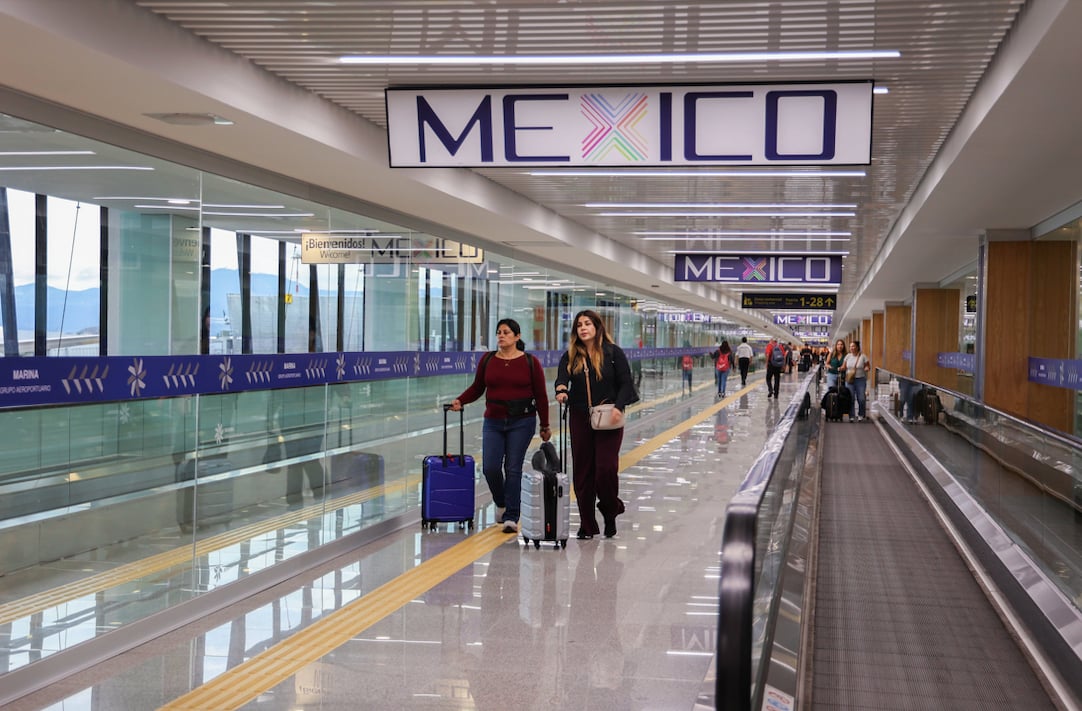
Mexico City International Airport (AICM) requires a comprehensive long-term infrastructure strategy that extends beyond the modernization works completed ahead of the 2026 FIFA World Cup, according to Peter Cerdá, Regional Vice President for the Americas, International Air Transport Association (IATA).
While airport authorities recently concluded the first phase of a MX$10 billion (US$576 million) renovation program, Cerdá said the next stage should prioritize strategic infrastructure planning capable of supporting Mexico’s aviation growth over the next several decades.
Speaking during the 82nd IATA Annual General Meeting and World Air Transport Summit in Rio de Janeiro, Cerdá acknowledged that the recent investments were necessary but argued that they primarily addressed operational and cosmetic improvements rather than the airport’s structural capacity constraints.
«The improvements were necessary, but there is still an important need to address structural aspects of the airport,» Cerdá said. He added that once World Cup preparations conclude, authorities should begin a comprehensive assessment of AICM’s long-term development plan.
According to Cerdá, future priorities should include runway capacity, taxiway optimization, and terminal expansion. «We need greater clarity on whether there will be a Terminal 3 and what will happen with Terminals 1 and 2. This is where we need better cooperation with the authorities,» he said.
His remarks come days after AICM announced the completion of the first phase of its infrastructure upgrade program, which delivered MX$6.5 billion (US$375 million) in improvements across 106 projects.
The completed works account for 65% of the total planned investment and include upgrades to boarding gates, immigration and customs facilities, baggage handling systems, drainage infrastructure, access roads, and terminal façades.
Airport authorities said all construction activities were carried out without disrupting normal flight operations. AICM currently serves approximately 45 million passengers annually and nearly 200,000 travelers each day, making it Mexico’s busiest airport and one of Latin America’s largest aviation hubs.
Adm. Juan José Padilla Olmos, CEO, Grupo Aeroportuario Marina and AICM, said the renovation program forms part of a broader federal strategy encompassing 106 infrastructure projects, with total investment expected to reach MX$10 billion upon completion.
President Claudia Sheinbaum said a significant share of the investment was directed toward repairing infrastructure damaged by land subsidence, including the reconstruction of drainage systems, electrical networks, and water infrastructure. She also emphasized that the program was financed entirely through airport-generated revenues rather than federal budget resources.
Despite these investments, Cerdá argued that Mexico must avoid one of the region’s most common infrastructure challenges: planning only for immediate operational needs. «Planning cannot be short-term. It has to be designed for the next 25 to 30 years,» he said.
IATA continues to view AICM as Mexico’s primary international gateway, while Felipe Ángeles International Airport (AIFA) and Toluca International Airport should serve as complementary facilities supporting demand across the metropolitan area.
According to Cerdá, long-term passenger growth will require a coordinated strategy involving airlines, airport operators, regulators, and government authorities. «We need a major reform involving terminals, airlines and runways so that we can respond to the positive forecasts we have for Mexico, because demand and connectivity will continue to grow,» he said…