

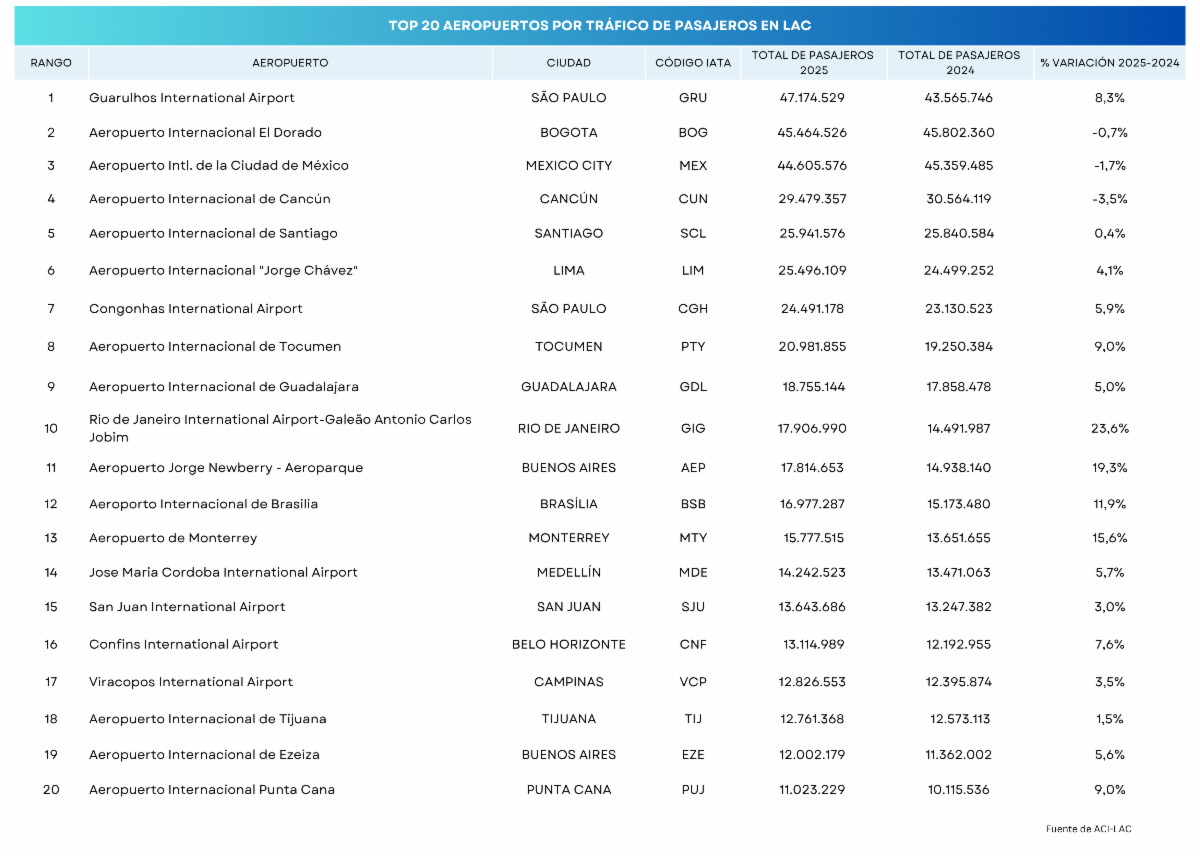
Airports Council International Latin America and the Caribbean (ACI-LAC) today released the consolidated data for the 20 busiest airports in the region in 2025. The information is part of the ACI World Airport Traffic Dataset 2026, published by Airports Council International (ACI World), and includes passenger traffic, air cargo volumes, and aircraft movements.
In 2025, the 20 busiest airports in Latin America and the Caribbean handled 440.4 million passengers, accounting for 55.4% of the region’s total passenger traffic. Collectively, these airports recorded 5.0% growth in passenger traffic, 1.8% growth in air cargo, and 3.0% growth in aircraft movements.
Among the key findings, Brazil and Mexico consolidated their positions as the region’s leading aviation markets in terms of both passenger traffic and aircraft movements. Meanwhile, Colombia maintained its leadership in air cargo and aircraft movements. These results underscore the strength of these countries within regional aviation and their growing importance on the global stage.
«The 2025 results reflect the strength and dynamism of aviation in Latin America and the Caribbean. Brazil, Mexico, and Colombia have consolidated their positions as key players in the region, driven by growing passenger demand, expanding operations, and the strategic role of their airports as connectivity and logistics hubs. These countries not only host some of the busiest airports in the region but also demonstrate the resilience and growth needed to strengthen regional aviation and its integration into the global air transport network,» said Rafael Echevarne, Director General of ACI-LAC.
Passenger Traffic
Among the region’s 20 busiest airports by passenger traffic, São Paulo/Guarulhos International Airport (GRU) ranked first, moving up two positions from the previous year. In 2025, the airport handled 47.1 million passengers, representing an 8.3% increase compared with 2024.
Meanwhile, El Dorado International Airport (BOG) and Benito Juárez International Airport (MEX) recorded slight declines in passenger traffic, handling 45.4 million and 44.6 million passengers, respectively.
Four airports posted particularly strong passenger traffic growth. Rio de Janeiro/Galeão International Airport (GIG) recorded the highest increase, with passenger traffic rising 23.6% between 2024 and 2025. It was followed by Jorge Newbery Airpark (AEP) in Buenos Aires (19.3%), Monterrey International Airport (MTY) (15.6%), and Brasília International Airport (BSB) (11.9%).
Overall, six of the region’s 20 busiest passenger airports are located in Brazil, while five are in Mexico, highlighting the importance of both countries to passenger traffic across Latin America and the Caribbean.
Air Cargo
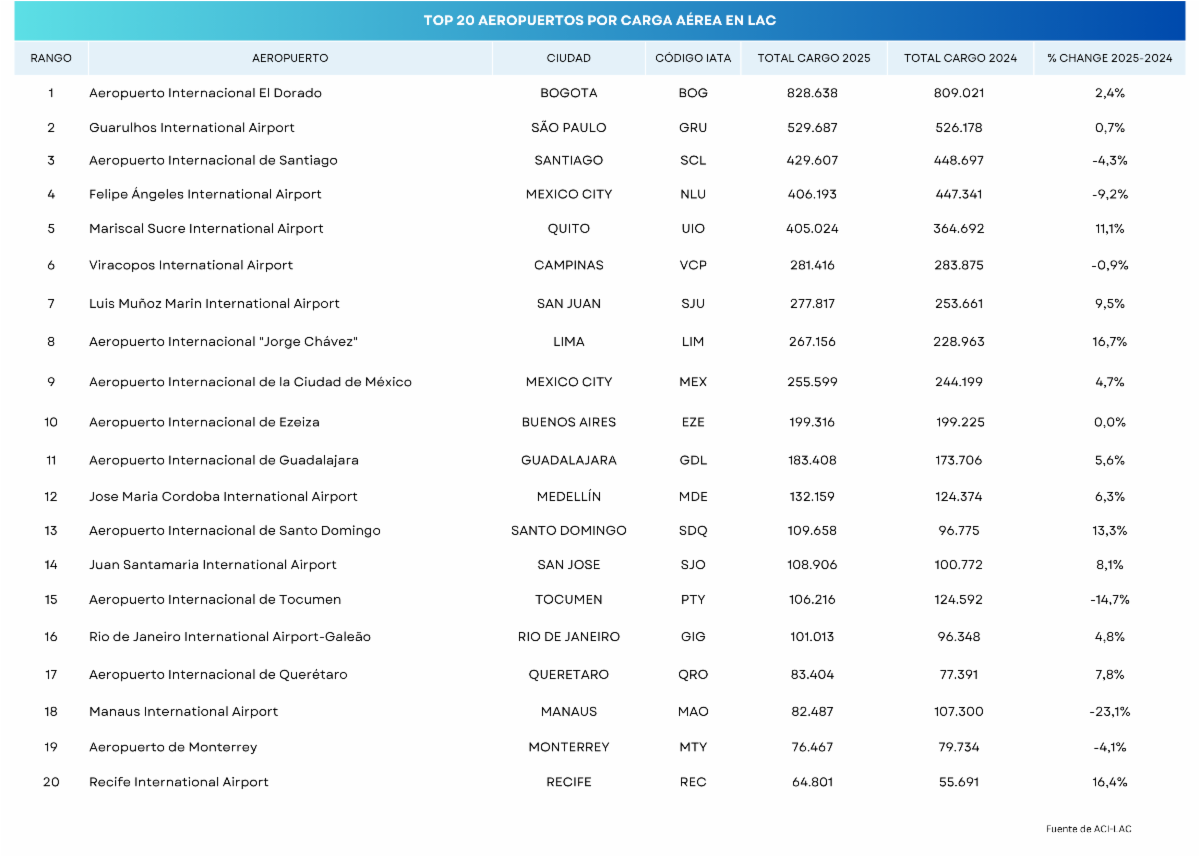
The 20 busiest airports in Latin America and the Caribbean handled more than 4.9 million metric tonnes of air cargo in 2025, a 1.8% increase compared with 2024, accounting for 76.6% of the region’s total air cargo volume.
El Dorado International Airport (BOG) remained the region’s leading air cargo hub, handling 828.6 thousand metric tonnes, followed by São Paulo/Guarulhos International Airport (GRU) with 529.6 thousand metric tonnes.
The highest cargo growth rates were recorded by Jorge Chávez International Airport (LIM) in Lima, which increased 16.7%, and Recife International Airport (REC), with 16.4% growth.
Aircraft Movements
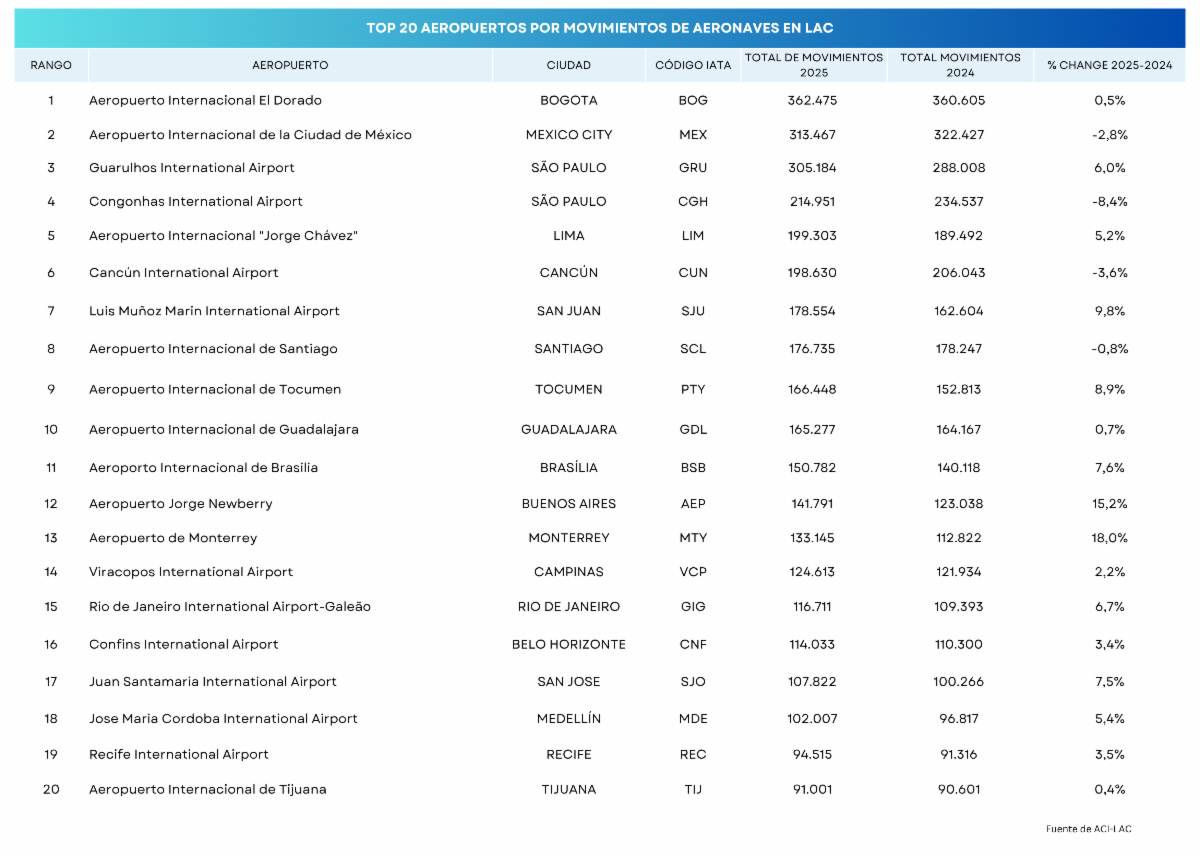
The region’s 20 busiest airports recorded approximately 3.46 million aircraft movements in 2025, a 3.0% increase compared with the previous year, accounting for 40.5% of the region’s total aircraft movements.
El Dorado International Airport (BOG) remained the region’s busiest airport by aircraft movements, with 362.4 thousand movements, followed by Benito Juárez International Airport (MEX) with 313.4 thousand movements.
The strongest growth in aircraft movements was recorded at Monterrey International Airport (MTY), which increased 18.0%, followed by Jorge Newbery Airpark (AEP) in Buenos Aires, with 15.2% growth.