

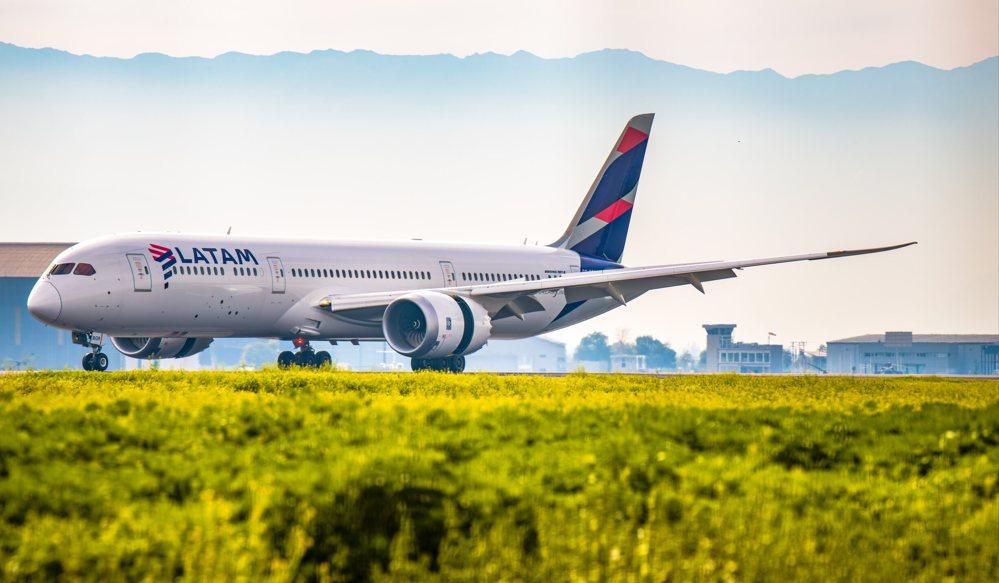
LATAM Airlines Group announced its financial results for the first quarter of the year, reporting an adjusted operating margin of 19.8% and net income of US$576 million. These results are driven by its business model, based on a differentiated value proposition for customers, operational excellence, and strong financial discipline, which provide the flexibility needed to navigate the current global economic environment. This financial strength is complemented by an extensive network, a diversified revenue base, and a robust loyalty program.
During the quarter, the group increased its capacity by 10.4%, transporting 22.9 million passengers, a 9.1% increase compared to the same period in 2025. This growth was driven by the performance of the international segment and the domestic market of LATAM Airlines Brazil. In this context, the group achieved a consolidated load factor of 85.3%. Meanwhile, cargo affiliates transported more than 250 thousand tons during the period, leading the flower season from Colombia and Ecuador to the U.S.
Adjusted EBITDA reached US$1.3 billion, demonstrating disciplined commercial execution despite an approximately US$40 million impact related to higher fuel prices during the period. In addition, LATAM generated US$391 million in cash, maintaining total liquidity above US$4.1 billion, or 27% of revenues over the last twelve months.
“LATAM began 2026 maintaining the trend seen in 2025 and consolidating its financial performance, with sustained growth in revenues, margins, and cash generation. This strength, enhanced by a diversified network, the advancement of the premium segment, and an efficient cost structure, provides the flexibility needed to manage fuel volatility and uncertainty for the remainder of the year,” said Ricardo Bottas, CFO of LATAM Airlines Group.
As a result of market volatility and uncertain current context, LATAM has replaced its 2026 guidance and updated its assumptions for fuel prices and exchange rates, estimating an adjusted passenger CASK (cost per available seat kilometer) excluding fuel of between 4.50 and 4.70 cents, and an adjusted EBITDA of between US$3.8 billion and US$4.2 billion. LATAM projects an adjusted net leverage ratio equal to or below 1.8x and liquidity of at least US$4.5 billion.
These new projections assume updated fuel cost assumptions of US$170 per barrel for the second and third quarters and US$150 per barrel for the fourth quarter. Another relevant update was the revision of the projected exchange rate for Brazil, from 5.5 to 5.15 (BRL/USD), which, together with the appreciation of other local currencies, drives an increase in adjusted passenger CASK excluding fuel.
LATAM expects additional fuel expenses exceeding US$700 million in the second quarter of 2026, considering a jet fuel price of US$170 per barrel. The impact on margins and cash flow is expected to be partially offset by a series of measures implemented since the beginning of the conflict, including revenue management actions, targeted capacity adjustments, additional cost control initiatives, liquidity measures for finances and working capital, as well as LATAM’s hedging policy. In terms of outlook for the second quarter, despite the significant fuel impact, LATAM expects to deliver a mid-to-low single-digit adjusted operating margin. All these elements are considered in the new 2026 guidance.
Key highlights of the period
In addition to its financial performance, LATAM group continues to redefine its value proposition. The group became the first Latin American airline to achieve a 4-star rating in the Skytrax World Airline Star Rating, a milestone in service quality.
In line with its focus on the corporate and high-value segment, LATAM announced that its future Airbus A321XLR fleet will feature a renewed Premium Business cabin, including fully flat seats and individual doors for maximum privacy.
Additionally, LATAM Airlines Group was reaffirmed by S&P Global as the 5th most sustainable airline in the world and the #1 in the Western Hemisphere for the second consecutive year. This recognition, along with its inclusion in the S&P Global Sustainability Yearbook, reflects the group’s efforts to contribute to the regions where it operates.
In April, LATAM Airlines Brazil and Delta Air Lines, Inc. announced a long-term commercial agreement for maintenance, repair, and overhaul (MRO) services in São Carlos (São Paulo), Brazil, focused on the repair of A320 family components.