

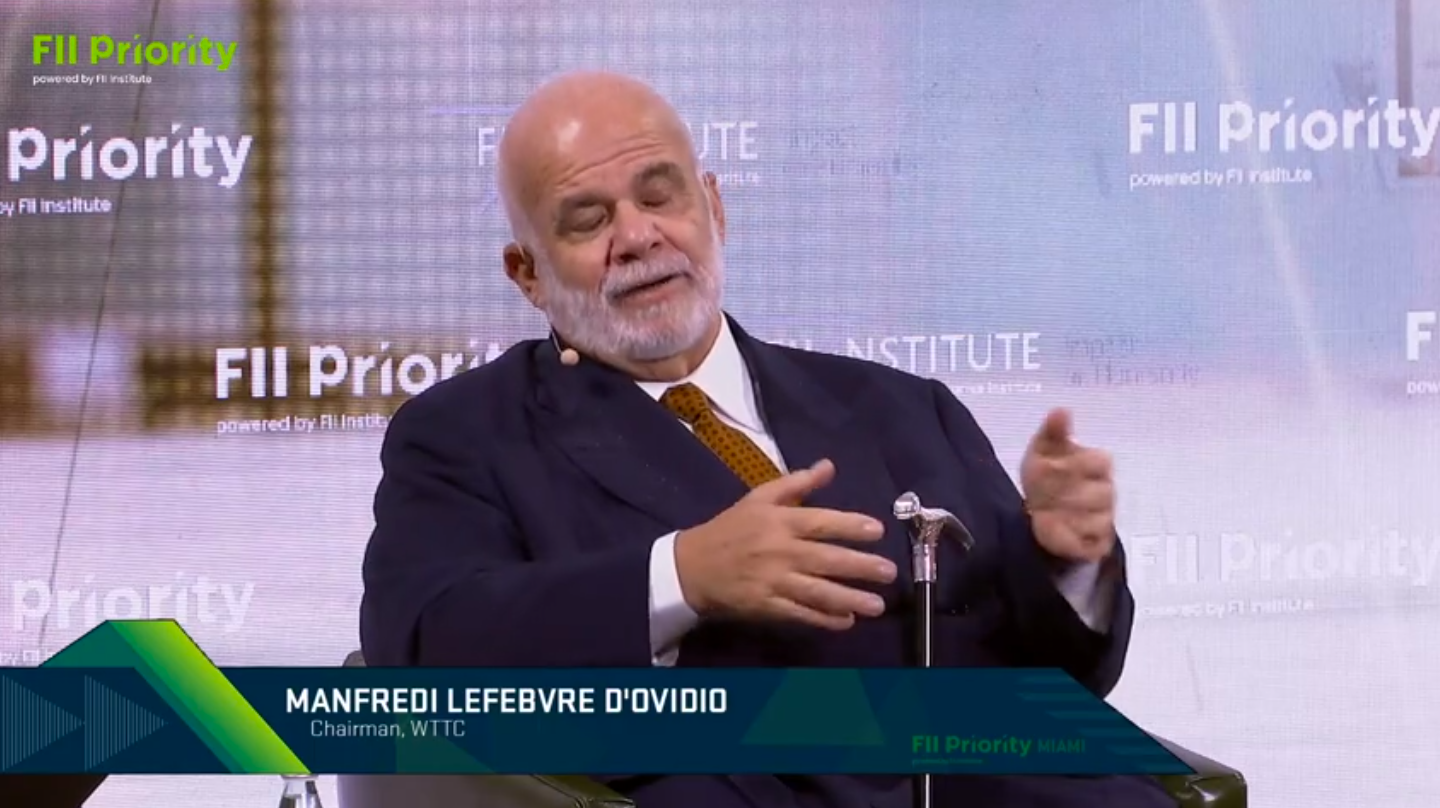
At the Future Investment Initiative in Miami, World Travel & Tourism Council Chairman Manfredi Lefebvre emphasized that infrastructure investment is a “growth multiplier,” highlighting tourism’s rising demand and warning that Latin America’s future hinges not on capital, but on effective execution.
In a ballroom overlooking the Atlantic in Miami Beach, the conversation was not about whether Latin America has potential. That question, for this audience, had long been settled.
Instead, the debate at the Future Investment Initiative PRIORITY Summit turned on something far more difficult—and far more consequential:
Why, despite decades of promise and billions in capital, has Latin America struggled to build the infrastructure needed to turn potential into sustained growth?
The session, titled “Enabling Conditions for Long-Term Investment in LATAM: Can Infrastructure Deliver?”, gathered investors, policymakers and industry leaders at a moment when global capital is shifting, supply chains are being redrawn, and emerging markets are once again competing for long-term attention.
Latin America, by most measures, should be well positioned. With a combined economic output of roughly $5 trillion, vast reserves of critical minerals, expanding cities and a young population, the region sits at the intersection of some of the most important trends shaping the global economy—from energy transition to food security.
And yet, as speaker after speaker made clear, the central obstacle is neither demand nor capital. It is execution.
A Region Defined by Contradiction
The contradictions are stark.
Nearly one-third of Latin Americans still lack access to basic infrastructure—roads, reliable electricity, water systems—conditions that would be considered foundational in developed economies. At the same time, global investors are actively searching for long-duration, real-economy assets capable of delivering stable returns in an uncertain world.
The mismatch is striking: a region in need of infrastructure, and a global market eager to finance it.
But between those two realities lies a gap—one defined by regulatory complexity, political volatility and a persistent shortage of what investors call “bankable projects.” “Capital is not the issue,” one participant said during the discussion. “Deploying it is.”
That distinction has become a defining theme not only of the Miami summit, but of the broader global investment landscape. In an era of higher interest rates and heightened geopolitical risk, capital has not disappeared—but it has become more selective, more disciplined, and less forgiving…